The musings, struggles and observations of an Englishman learning Welsh.
All Posts
Search Posts
Donate! Buy me a coffee!
If you play and enjoy Help Hannah's Horse or Barkout, or just like this site and you'd like to say thanks, please consider buying me a coffee:

Search Results (4 posts found):
When I first got a PC in the 1990s, you'd buy games by going somewhere like Electronics Boutique, GAME, or PC World, or you'd mail order from a magazine. However you bought it, your new game would most likely come in a big cardboard box on a CD (or floppy disk, if you're suitably old like me), with a printed manual and, if you were lucky, extra merch like stickers, story books, posters, or other game related items like maps.
These days, in the era of downloads, all those extra bits have gone by the wayside and the joy of having a shelf full of boxed games has gone with them.
This got me thinking about my own games. I realise these are not blockbuster hits and almost no one is playing them, but I did wonder if it might be fun to create a boxed release of Barkout with screenshots on the back, naff artwork on the front, and a printed manual, just for my own amusement.
So, when I can find the time, I may do just that. I'll probably start with a simple jewel case release to see if I can pull it off, before moving on to a cardboard box. Either way, it'll be another opportunity for a bit of creativity and nostalgia mixed into one.
I'm sure many adult learners have done it: started learning a new language and bought children's books in order to aid with their learning. I've done it. One of the first Welsh books I bought, besides a dictionary, was "Ydw i'n fach?" by Philipp Winterberg.
It's a beautifully illustrated book designed to teach children new adjectives of size, and to teach them that although we may be different, we are all perfect. It's a lovely book.
But it's not suitable for adults. Once you've learned a handful of adjectives for big things, and a handful of adjectives for small things... that's it. It's a trap I'm sure many learners have fallen into: aiming too low. We think our limited vocabulary as learners mean we should buy books aimed at children, but ultimately there's no benefit in this. The vocabularly we need as adults is very different to the vocabulary we need as children, and we need to learn to structure sentences the way adults do. You can't get this from simple, children's picture books.
The next mistake is to realise the first mistake and over-correct by buying books aimed at older children. The problem here is that native-speaking older children, for whom the *subject matter* may be closer to that of an adult, have a vocabulary and comprehension of the target language far better than that of an adult learner.
Where Welsh excels is with its glut of excellent books aimed directly at second-language adult learners of all abilities. There's an excellent range of novels written by a pool of talented authors that address exactly the issues faced by adult learners of a language: that the range of vocabulary is appropriate, the pace of learning is appropriate and the subject matter is appropriate. And generally these books, unlike books aimed at native speakers, include a glossary of new terms at the bottom of each page as well as, often, a complete glossary at the end of the book. Publishers like Gwasg Gomer and Atebol produce books aimed specifically at different levels of learner, with each book marked to show at which level learner it is aimed: mynediad, sylfaen, canolradd, or uwch, so that a learner of any ability can find something to enjoy. Some books, like Ffenestri by Lois Arnold, contain a collection of short stories and poems broken down into sections with each section aimed at a different target level, so you can stick with the same book as your ability improves!
I've realised that this blog has strayed somewhat from my original aim of it being about my journey of learning Welsh, and more just my opinion on various language-related things.
So, in a return to its true purpose, this post is a review of the book "Yn Ei Gwsg" (In His Sleep) by Bethan Gwanas.
Dafydd walks in his sleep. It's part of the reason, he suspects, for the breakup of his marriage and it gets him into all sorts of odd situations with his neighbours. One morning, however, it takes a more sinister turn when he wakes up covered in blood - not his own - and sets off with his faithful dog Wmffra to follow the bloody footprints to find out to whom the blood belongs.
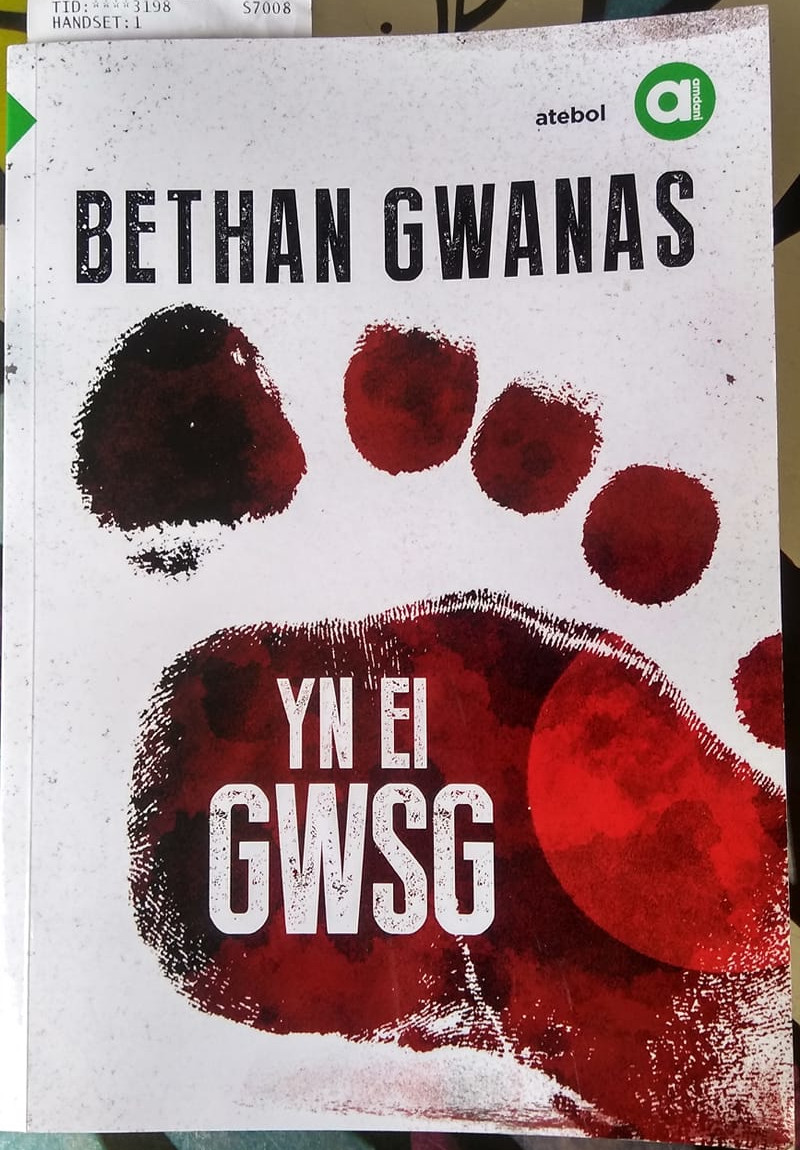
The book is not nearly as dark as that synopsis makes it sound. It's actually very light-hearted, humorous and a touch sad in places. Bethan Gwanas writes novels for native Welsh speakers as well as learners, and I think that helps her keep this novel simple yet clearly aimed at adults. The language used has clearly been thought about so that the level remains suitable for the target audience, yet also shows a progression from start to finish and introduces new words and phrases.
I really enjoyed reading it. Unusually for me, I found I could hardly put it down. I think this was partly because it was genuinely an enjoyable story, and partly because the level was pretty much spot-on for my ability (this is set as Lefel Sylfaen) so I found I was able to read straight through most pages without having to resort to a dictionary (the glossary of new terms at the bottom of each page, as is common for Welsh-for-adults books, helps enormously). The language used is more northern in style, but I didn't find this a hindrance at all - in fact it helped to cement some knowledge of northern dialect that I'm bound to encounter in the wild anyway.
The last book I read before this was "Ffenestri" by Lois Arnold. If you've read up to the end of the Sylfaen level in that, you shouldn't have any problems with this and I'd recommend it as not only a good book for learners, but a good read in its own right.
So, in a return to its true purpose, this post is a review of the book "Yn Ei Gwsg" (In His Sleep) by Bethan Gwanas.
Dafydd walks in his sleep. It's part of the reason, he suspects, for the breakup of his marriage and it gets him into all sorts of odd situations with his neighbours. One morning, however, it takes a more sinister turn when he wakes up covered in blood - not his own - and sets off with his faithful dog Wmffra to follow the bloody footprints to find out to whom the blood belongs.
The book is not nearly as dark as that synopsis makes it sound. It's actually very light-hearted, humorous and a touch sad in places. Bethan Gwanas writes novels for native Welsh speakers as well as learners, and I think that helps her keep this novel simple yet clearly aimed at adults. The language used has clearly been thought about so that the level remains suitable for the target audience, yet also shows a progression from start to finish and introduces new words and phrases.
I really enjoyed reading it. Unusually for me, I found I could hardly put it down. I think this was partly because it was genuinely an enjoyable story, and partly because the level was pretty much spot-on for my ability (this is set as Lefel Sylfaen) so I found I was able to read straight through most pages without having to resort to a dictionary (the glossary of new terms at the bottom of each page, as is common for Welsh-for-adults books, helps enormously). The language used is more northern in style, but I didn't find this a hindrance at all - in fact it helped to cement some knowledge of northern dialect that I'm bound to encounter in the wild anyway.
The last book I read before this was "Ffenestri" by Lois Arnold. If you've read up to the end of the Sylfaen level in that, you shouldn't have any problems with this and I'd recommend it as not only a good book for learners, but a good read in its own right.
Christmas has been and gone and I've now got a small collection of Welsh books aimed at learners. I already had "Ffenestri" by Lois Arnold, and I now have two Bethan Gwanas books to add to my growing library: "Yn ei Gwsg" and "Bywyd Blodwen Jones".
I've started the Blodwen Jones one, but to my shame I have only made it about three pages in. It's not because it's too difficult (it's actually about right for me), it's because life, as it is wont to do, has taken over.
That's also why I haven't been updating this blog very often: I just don't find the time.
My Welsh learning is still continuing apace though. My DuoLingo tree is now almost entirely level five (nothing below a four) and I've moved onto level two on Say Something In Welsh. The range of things I can say in Welsh now far outstrips what I can say in French, and I started learning that when I was 11 at school!
What I lack is someone to speak Welsh with. No one else in the house is interested in learning, and I suspect wouldn't stick with it long if they did. It may be time to venture out and maybe go to a meet up in Bristol or Casnewydd.