The musings, struggles and observations of an Englishman learning Welsh.
All Posts
Search Posts
Donate! Buy me a coffee!
If you play and enjoy Help Hannah's Horse or Barkout, or just like this site and you'd like to say thanks, please consider buying me a coffee:

Search Results (4 posts found):
When I first got a PC in the 1990s, you'd buy games by going somewhere like Electronics Boutique, GAME, or PC World, or you'd mail order from a magazine. However you bought it, your new game would most likely come in a big cardboard box on a CD (or floppy disk, if you're suitably old like me), with a printed manual and, if you were lucky, extra merch like stickers, story books, posters, or other game related items like maps.
These days, in the era of downloads, all those extra bits have gone by the wayside and the joy of having a shelf full of boxed games has gone with them.
This got me thinking about my own games. I realise these are not blockbuster hits and almost no one is playing them, but I did wonder if it might be fun to create a boxed release of Barkout with screenshots on the back, naff artwork on the front, and a printed manual, just for my own amusement.
So, when I can find the time, I may do just that. I'll probably start with a simple jewel case release to see if I can pull it off, before moving on to a cardboard box. Either way, it'll be another opportunity for a bit of creativity and nostalgia mixed into one.
One tiny thought about writing your own games, is that playing them isn't as much fun as playing games written by other people. This applies even if you're pleased with how the game turned out, and the main reason is that part of the attraction of playing a game is to see what comes next. In Sim City you keep building a population to see what rewards you get; in Transport Tycoon it's to see what new vehicles appear; in Arkanoid it's to see what new level designs and bonuses await. When you write your own game, you're already aware of what awaits you, even if your game is sufficiently difficult that you can't get there.
With Barkout, I know what levels I created, I know what bonuses there are, and I know what the final boss looks like and how to defeat him.
Knowing these things does take a lot of the fun out of the game, even if the mechanics themselves are spot on.
With Barkout, I know what levels I created, I know what bonuses there are, and I know what the final boss looks like and how to defeat him.
Knowing these things does take a lot of the fun out of the game, even if the mechanics themselves are spot on.
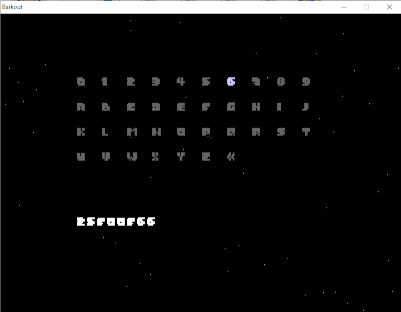
After a few months of not looking at it, I've recently been working on making a few old-school improvements to Barkout, namely a continue code-style save game mechanism, and a new power up in the form of a multi-ball bonus, common in most other Arkanoid clones.
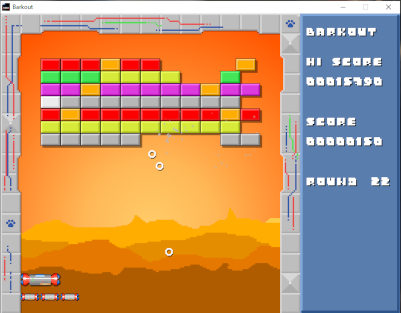
Above, the multi-ball powerup in action.
Below, using the Continue screen to enter a code.
The purpose of Barkout all along has simply been to get some practice in C programming. Initially, it was so I could help a family member who had started a C programming course at university, but it then evolved into doing it just because I enjoyed it. C is a great language to program in. It's also just a nostalgia trip for me; trying to program the sorts of games that I played on my first computer in the 80s: an Amstrad CPC6128.
Anyway, the fruit of my effort is that Barkout version 1.2.0 has now been released and can be found by following the "Free Games!" icon in the top menu.
Above, the multi-ball powerup in action.
Below, using the Continue screen to enter a code.
The purpose of Barkout all along has simply been to get some practice in C programming. Initially, it was so I could help a family member who had started a C programming course at university, but it then evolved into doing it just because I enjoyed it. C is a great language to program in. It's also just a nostalgia trip for me; trying to program the sorts of games that I played on my first computer in the 80s: an Amstrad CPC6128.
Anyway, the fruit of my effort is that Barkout version 1.2.0 has now been released and can be found by following the "Free Games!" icon in the top menu.
This week I released a new game: Barkout!
It's a very vaguely dog-themed Arkanoid / Breakout clone coded in C making use of SDL for graphics, sound, and input.
If you've played Arkanoid, you know what to expect: balls, bricks, bonuses and baddies.

Why make a 2D game in 2024? Well, I like to make the sorts of games I used to play as a child in the 80s and 90s, and Arkanoid was one of my favourites, and one of the few I actually owned a genuine copy of for my Amstrad CPC6128.
Barkout is available in source code form, as well as a Windows 64 bit installer, from the game homepage which can be found by following the "Free Games!" link in the top menu or right here
It's a very vaguely dog-themed Arkanoid / Breakout clone coded in C making use of SDL for graphics, sound, and input.
If you've played Arkanoid, you know what to expect: balls, bricks, bonuses and baddies.
Why make a 2D game in 2024? Well, I like to make the sorts of games I used to play as a child in the 80s and 90s, and Arkanoid was one of my favourites, and one of the few I actually owned a genuine copy of for my Amstrad CPC6128.
Barkout is available in source code form, as well as a Windows 64 bit installer, from the game homepage which can be found by following the "Free Games!" link in the top menu or right here