The musings, struggles and observations of an Englishman learning Welsh.
All Posts
Search Posts
Donate! Buy me a coffee!
If you play and enjoy Help Hannah's Horse or like this site and you'd like to say thanks, please consider buying me a coffee on:

Search Results (10 posts found):
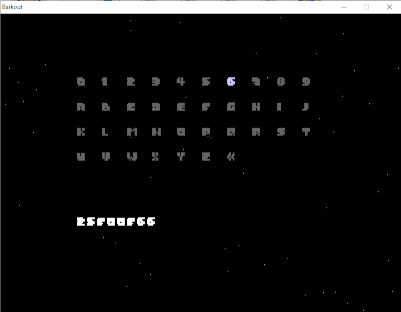
After a few months of not looking at it, I've recently been working on making a few old-school improvements to Barkout, namely a continue code-style save game mechanism, and a new power up in the form of a multi-ball bonus, common in most other Arkanoid clones.
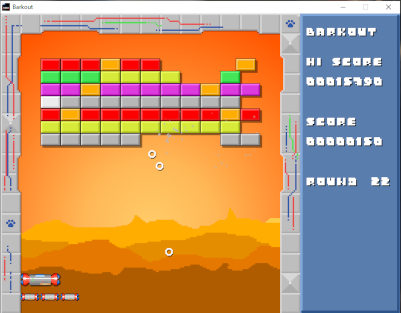
Above, the multi-ball powerup in action.
Below, using the Continue screen to enter a code.
The purpose of Barkout all along has simply been to get some practice in C programming. Initially, it was so I could help a family member who had started a C programming course at university, but it then evolved into doing it just because I enjoyed it. C is a great language to program in. It's also just a nostalgia trip for me; trying to program the sorts of games that I played on my first computer in the 80s: an Amstrad CPC6128.
Anyway, the fruit of my effort is that Barkout version 1.2.0 has now been released and can be found by following the "Free Games!" icon in the top menu.
Above, the multi-ball powerup in action.
Below, using the Continue screen to enter a code.
The purpose of Barkout all along has simply been to get some practice in C programming. Initially, it was so I could help a family member who had started a C programming course at university, but it then evolved into doing it just because I enjoyed it. C is a great language to program in. It's also just a nostalgia trip for me; trying to program the sorts of games that I played on my first computer in the 80s: an Amstrad CPC6128.
Anyway, the fruit of my effort is that Barkout version 1.2.0 has now been released and can be found by following the "Free Games!" icon in the top menu.
Sir Lucien (Geoffrey Whitehead) made his name in the 60s as the most brutal of the brutalists. Unfortunately, times have changed and his love of all things concrete means his practice of misfits now only get commissioned to build car parks. Lucien is joined by his loyal-ish employees Matt (Dominic Coleman), Sarah (Ingrid Oliver (series 1), Anna Crilly (series 2)), Tim (Alex Carter) and Hayley (Aisling Bea) as they struggle to stay relevant in the 21st century.

The Architects is a new one for me. I must have missed it during its runs on the radio, and I came to it quite by chance while browing The Internet Archive. There are two series of four episodes plus one pilot. I won't discuss the pilot here as the cast was almost entirely different.
Sir Lucien is a typically Whiteheadian character: pompous, brusk, and verbose and is as enjoyable as any Geoffrey Whitehead incarnation.
Matt is, again, a typical Dominic Coleman character. A fairly likeable everyman, although occasionally prone to showing off his apparent knowledge of the world of architecture, only to have it corrected by someone else. He considers himself something of an architectural genius, but is somewhat deluded.
Sarah, sadly, falls into the trap of being the typical radio comedy token woman. Single, frustrated, and neurotic but clever, usually getting the better of her male counterparts. There's nothing wrong with this per se, but we've seen this character before in Sophie from Think the Unthinkable and Dr Ruth from Rigor Mortis, to name but two.
Tim is a strange one. Half sycophant, half dimwit. There's an undercurrent of dislike between him, Matt and Sarah, and yet there never seems to be any real acrimony towards them. In fact, in later episodes there's a degree of cameraderie between all three, as if the writers forgot what sort of character Tim was supposed to be. Tim starts as an unlikeable brown noser who keeps his distance from Sarah and Matt in order to suck up to Sir Lucien, but later in the show becomes more part of the team. At various times he's shown to be both a socially awkward, stamp collecting, battle re-enacting geek who makes poor attempts to come on to women and at the same time a bit of a ladies' man who has some success with them. He is sometimes shown to be so dim that you wonder how he passed the many years of education needed to become an architect.
For the first couple of episodes I found very little to laugh at, but as it progressed and the characters grew to become more of a team, the jokes also improved and I did find myself chuckling out loud on a number of occasions. The initial problems were that some of the characters didn't know quite who they wanted to be. Hayley, the receptionist, starts off a a bit of a ditz who, apparently, doesn't know that Deutschland and Germany are the same thing, nor that Deutsch and German are the same language, yet later in the series she's shown to be quite smart and easily holds her own in arguments with the architects, particularly Tim. She also seems to have little purpose other than as a foil for the other characters and plays little part in most of the plots, which might explain why she's quietly dropped in series 2, her absence explained as her being in prison.
I think the other problem with the program is the limited story lines you can do around an architectural firm. The setting of an architectural practice limits the potential situations in a way that the superficially similar Think The Unthinkable managed to avoid. Most of the plots revolve around the firm trying and failing to secure commissions for various architectural projects, from airports to renovating houses and restaurants. A lot of what that they do seems to border on interior design, rather than architecture, but I suppose purely architectural themed storylines were more limiting still.
And I suppose that's a good summary. It's a decent comedy that grows on you, but is never quite sure what it's trying to be.
I'll probably find myself listening to it all over again at some point, but I won't be hurrying to do so.
Rating: * * *
I admit, I've been a bit remiss in both updating this site and in learning Welsh.
The problem is finding the time.
A while ago, back in July, I lost my DuoLingo streak of more than two years and with it any incentive to keep up with my DuoLingo practice.
I suppose that's the problem with DuoLingo: once the addiction of keeping your streak going wears off, and if you've already completed the language tree, there's not much to keep you going back, as it's all just more of the same.
I could have carried on with Say Something In Welsh, but again it's finding the time. I used to do it while driving, but I generally prefer to listen to radio comedy these days, so my Welsh gets neglected.
And I know my Welsh is suffering for it, as I keep encountering words that I know I know, but of which I can suddenly no longer remember the meaning.
I need to make more of an effort. I'll keep you posted!
When the Dog Dies is a gentle comedy starring Ronnie Corbett and Liza Tarbuck as retiree Sandy Hopper and his younger lodger Delores, respectively. The dog in question is Sandy's mongrel Henry. The series is written by Ian Davidson and Peter Vincent, the same team behind Corbett's 1980s television comedy series, "Sorry!".

The premise is that Sandy will downsize from his family home and release equity for his children "when the dog dies".
Most of the plots revolve around the various farsical situations Sandy gets himself into, or the schemes of his children to get him to move home or otherwise part with some of his money.
It's a gentle comedy, not one full of belly laughs but one which makes me chuckle from time to time. My biggest complaint is that too many of the characters are just fundamentally unlikeable.
Sandy is a rule-obsessed retired "acting manager" of the Five Feathers, Frinton, forever posting (and changing) house rules to which Delores must abide.
Delores is probably the only truly likeable character in the programme. Relentlessly optimistic, cheerful, and always looking out for Sandy when his family inevitably try to scam him. She also enjoys a good relationship with Henry.
Lance is Sandy's grown up son. A teacher, he's a bit wet and forever on the scrounge to borrow money from Sandy, but he's not entirely unsympathetic. He has an unpleasant, adulterous wife, Victoria, and a teenage daughter called Calais, named as such because she was conceived on a cross-channel ferry.
Ellie is Sandy's grown up daughter. Always sounding like she's on the verge of a breakdown, she considers Sandy's eventual bequest to already be her money, and despairs of him spending any of it before he leaves it to her. She's married to the entirely unlikeable, borderline psychopathic security and surveillance equipment salesman Blake who at various times tries to trick Sandy into giving him power of attorney, cons him into sponsoring him for a road race, and leaves him floating out to sea in a caravan. His schemes often involve tracking or bugging Sandy or his home so he can monitor Sandy's spending. He and Ellie are both convinced that Sandy is romantically involved with Delores. Ellie and Blake's children are Tyson and Zoe, who Blake essentially tortures by insisting on a brutal exercise regime for Tyson and seemingly non-stop sessions of musical instrument practice for Zoe.
Pom-Pom's Mummy is another dog owner who Sandy frequently meets while walking Henry. She initially appears as quite a sympathetic character, but later it becomes more apparent that she too has quite a nasty, jealous streak in her. She covets Sandy and is quite jealous of Delores' relationship with him.
Overall, When the Dog Dies isn't a bad series, it's just not one I'd return to. There are no standout memorable episodes, and I spent a lot of time wondering why Sandy didn't report Blake for his borderline illegal (probably actually illegal, in some cases) activities.
Rating: * *
Regular visitors (just me then) will have noticed a change to the design of RetroJunkies.co.uk.
The right-hand panel containing the recent posts, search, blurb and links has been moved to the left-hand side, and the main content is now to the right.
I've also changed the title font to Hand Drawn Objects, a free web font I found online, and the main font to the brilliantly named "Aaargh". It just makes the whole place look a little more polished.
To that end, I've also taken the opportunity to learn a bit about responsive web design. That is, making pages fit the device on which they're being viewed. In this case, I've changed the site so that when viewed on a small screen (like a mobile phone) the left panel is reduced and, as with the main panel, appears the whole width of the screen.
I've also improved my own logging-in facility for when I make posts. It turns out I'd been forgetting to actually validate the username entered at login. It's a wonder I haven't been hacked yet.
There's method to my madness. I've been attending university open days for my partner's son, and I've realised that some of my skills are absent or falling by the wayside a little. Among them my web design (css, javascript) and PHP abilities, so I'm using this site as practice for those skills.
Any comments on the look are gratefully received.
Mae'n amser eisteddfod ar lein eto!
It's online eisteddfod time again!
Every year, alternating between locations in the North and South of Wales, is the National Eisteddfod (Eisteddfod Gynedlaethol), a celebration of Welsh language, music and culture with bands, singers, poets authors and more besides.
And every year, SaySomethingInWelsh.com runs an "Online Eisteddfod" for members and non-members to practice their Welsh by speaking, writing or singing reviews, poems, songs and prose that they've written. The entries are judged and a winner chosen for each category.
I really enjoy the online Eisteddfod. It gives me a chance to practice my Welsh and enjoy what others have created with theirs.
Last year I was the only entrant for the Beginner Prose category, so of course I won by default. This year I have entered the Englyn Milwr (a short, three line poem on a given theme) and the Post-Beginner Prose. I'm not sure my Welsh is really good enough for post beginner, but I didn't want to run the risk of being the only entrant for the beginner category again!
Entries close on 2019-11-14 and voting takes place the following week. Let's see how I do. Fingers crossed...!
I've started making it part of my morning routine to listen to the BBC's Welsh language offering, Radio Cymru, on the way to work. I don't listen for very long, only the 20 minute drive to work, but the idea is that it gets me used to hearing the language and its rhythms and tempo.
And I don't really understand very much of it. I can pick out quite a few words, but not enough to understand whole sentences, although I do have one complete sentence under my belt from the breakfast show one morning: "Mae'r plant yn hoffi y ceffyl, a'r ceffyl yn hoffi'r plant" (the children like the horse, and the horse likes the children). I can just about follow the weather, and if I know some of the topics already, I can understand a little of the news.
Hopefully as time goes on, and in conjunction with my other practices, I'll start to understand more. What's important to remember, and what another learner pointed out, is that Radio Cymru is aimed at *native* speakers; not learners, so being able to understand any of it is a bonus.
Following my first tuning-in, I tweeted that I'd started listening and got a reply and some likes from Radio Cymru presenters, which was encouraging. The reply simply said "Dal ati!" (keep at it). I intend to.
Actually I'm annoyed with myself.
And I'm annoyed with the people of Pembrokeshire! We went for a family holiday for a week to Pembrokeshire (beautiful, by the way) and I managed to speak almost no Welsh. The problem was mostly that I encountered virtually no one who spoke Welsh! Or at least no one who advertised the fact if they did.
I say "almost no Welsh" because I listed the items in my shopping basket in Welsh to my step-daughter, and I replied with "Dw i'n siarad tipyn bach Cymraeg, hefyd" when confronted with the reply of "tipyn bach" to my question of "Do you speak Welsh?" to a shopkeeper.
And that was it. I overheard someone at Castell Henllys speaking Welsh, but they'd gone by the time the demonstration I was watching had finished, otherwise I might have asked to practice a little with them (although God knows what I'd have said).
It's a shame, really. An opportunity missed. My Welsh comprehension is now getting beyond the Mynediad (entry) level, but my listening and speaking have had very little practice.
Still, I was at least surrounded by written Welsh: road signs, shop signs, leaflets, and I took the time to watch a little S4C, so all was not lost.
This is something I've started feeling quite strongly about lately, although I admit I'm partial to a bit of bias given my current enthusiasm for Cymraeg, but...
...why don't we teach Welsh as a second language in England? I say England because in Scotland and Northern Ireland they already have native languages that should be taught, but England does not.
I know some people will think, "Are you mad?!" but hear me out; my reasoning is sound:
1. Many children are more likely to visit Wales than Germany. German is taught in many British schools, yet British tourists to Germany number around 2 million per year compared to 10 million in Wales (2015 figure). This means more chance to practice a language learnt in school.
2. Welsh is the language of these islands. English people may not appreciate this, but our ancestors spoke something similar to Welsh. Before the Romans, Saxons and then Normans invaded, the native languages of these islands were the Brythonic languages, of these Welsh is the one currently in the healthiest state. Learning Welsh is a link to our past, even as Englishmen.
3. Learning any language has benefits beyond just that language. Learning one language helps a child understand other languages and their own language much better. There is nothing to be lost by learning Welsh and much to be gained.
4. Welsh is different. Welsh is not like French, German or Spanish; the languages children usually learn in school. The structure is different and it borrows little from Romance or Germanic languages. Learning Welsh gives children a different perspective on language learning yet remains relevant as it's spoken as a living language by 700,000 people and is an official language of the UK, unlike Cantonese, Mandarin or Satsuma ;)
5. Welsh is easy. Well, sort of. As I've covered previously, simple Welsh sentences in the past, present and future tenses can involve very little conjugation beyond the verb "bod" (to be). This makes progress fast and enthuses children to learn. Why spend two years mastering present tense conjugations in French when you can learn the same sentences in Welsh in a fraction of the time?
Not everyone will agree with me. I know the counter argument will be "but more people speak language X than speak Welsh!" or the usual "Welsh is a dead language! What's the point?!". But Welsh is growing. By teaching it as a second language it will grow more and these questions will answer themselves.
On Saturday I was crossing the Second Severn Crossing into Wales and, of course, I stopped at the toll booth to pay the crossing toll. The man operating the booth greeted me with a fairly cheery, "Hello" and I replied likewise, paid, thanked him and drove off. As we left, Lulu said, "Why didn't you say thank you in Welsh?" and I replied "Because I didn't know if he spoke Welsh".
I know I've mentioned this previously, but it still strikes me as odd. I'm entering Wales, but I can't guarantee that the (presumably) Welshman I'm talking to can speak the language of his nation. Later in the supermarket, the same thing. The (very clearly) Welsh lady greeted me, we had a chat about the weather and Cardiff in general, I thanked her and I left. Again, it would have been great to practice a bit of Welsh with her, even a "S'mae!" or "Prynhawn da", but again I couldn't be sure that she'd be able to speak Welsh.
Funnily enough I'd have been more confident that younger people spoke the language than older people, due to the push that's been made in recent years with teaching it in schools and some schools being entirely Welsh medium. This is in contrast to other indiginous languages of the UK, such as Scottish Gaelic, where the vast majority of speakers are older people and the languages are, quite literally, dying out.
The Welsh government is pushing for 1,000,000 Welsh speakers by 2050, and DuoLingo reports more users than that learning Welsh now, although I don't know how many live in the UK, so hopefully it won't be too long before I can know beforehand that it's safe to speak Welsh to a Welshman in Wales!