The musings, struggles and observations of an Englishman learning Welsh.
All Posts
Search Posts
Donate! Buy me a coffee!
If you play and enjoy Help Hannah's Horse or Barkout, or just like this site and you'd like to say thanks, please consider buying me a coffee:

Search Results (3 posts found):
Welcome to the Radio Comedy Review blog.
Radio comedies are a largely ignored slice of the radio programming pie. Plenty of people don't stray from music stations when listening to the radio, and many people think of spoken-word stations as being the place only for news and current affairs.
I first became aware of radio comedies when flicking through digital stations late one night many years ago. I stopped on a spoken-work station and did something quite unexpected.
I laughed.
I don't remember the programme I was listening to, but the station was BBC Radio 7 (now BBC Radio 4 Extra) and I became hooked on all sorts of programmes hitherto unknown to me: Paul Temple stories, The News Quiz, The Adventures of Sherlock Holmes, Poirot, Miss Marple and, of course, all sorts of comedy programmes and panel shows.
Over the last few years I've spent a lot of time listening to BBC radio comedies, either downloaded from the internet, streamed from BBC Sounds, or live on Radio 4 Extra, and I decided to share my opinions of those programmes with others who might be interested in finding something new to listen to.
So here are those opinions, in no particular order.
I've realised that this blog has strayed somewhat from my original aim of it being about my journey of learning Welsh, and more just my opinion on various language-related things.
So, in a return to its true purpose, this post is a review of the book "Yn Ei Gwsg" (In His Sleep) by Bethan Gwanas.
Dafydd walks in his sleep. It's part of the reason, he suspects, for the breakup of his marriage and it gets him into all sorts of odd situations with his neighbours. One morning, however, it takes a more sinister turn when he wakes up covered in blood - not his own - and sets off with his faithful dog Wmffra to follow the bloody footprints to find out to whom the blood belongs.
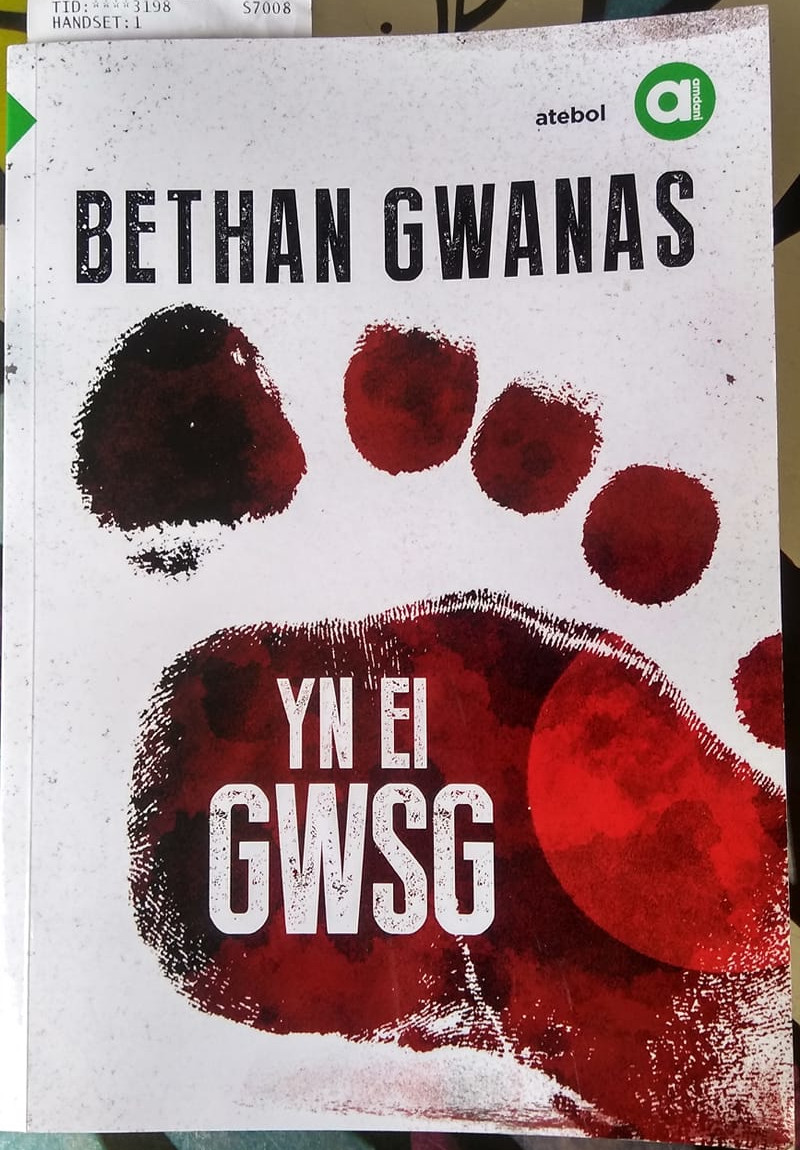
The book is not nearly as dark as that synopsis makes it sound. It's actually very light-hearted, humorous and a touch sad in places. Bethan Gwanas writes novels for native Welsh speakers as well as learners, and I think that helps her keep this novel simple yet clearly aimed at adults. The language used has clearly been thought about so that the level remains suitable for the target audience, yet also shows a progression from start to finish and introduces new words and phrases.
I really enjoyed reading it. Unusually for me, I found I could hardly put it down. I think this was partly because it was genuinely an enjoyable story, and partly because the level was pretty much spot-on for my ability (this is set as Lefel Sylfaen) so I found I was able to read straight through most pages without having to resort to a dictionary (the glossary of new terms at the bottom of each page, as is common for Welsh-for-adults books, helps enormously). The language used is more northern in style, but I didn't find this a hindrance at all - in fact it helped to cement some knowledge of northern dialect that I'm bound to encounter in the wild anyway.
The last book I read before this was "Ffenestri" by Lois Arnold. If you've read up to the end of the Sylfaen level in that, you shouldn't have any problems with this and I'd recommend it as not only a good book for learners, but a good read in its own right.
So, in a return to its true purpose, this post is a review of the book "Yn Ei Gwsg" (In His Sleep) by Bethan Gwanas.
Dafydd walks in his sleep. It's part of the reason, he suspects, for the breakup of his marriage and it gets him into all sorts of odd situations with his neighbours. One morning, however, it takes a more sinister turn when he wakes up covered in blood - not his own - and sets off with his faithful dog Wmffra to follow the bloody footprints to find out to whom the blood belongs.
The book is not nearly as dark as that synopsis makes it sound. It's actually very light-hearted, humorous and a touch sad in places. Bethan Gwanas writes novels for native Welsh speakers as well as learners, and I think that helps her keep this novel simple yet clearly aimed at adults. The language used has clearly been thought about so that the level remains suitable for the target audience, yet also shows a progression from start to finish and introduces new words and phrases.
I really enjoyed reading it. Unusually for me, I found I could hardly put it down. I think this was partly because it was genuinely an enjoyable story, and partly because the level was pretty much spot-on for my ability (this is set as Lefel Sylfaen) so I found I was able to read straight through most pages without having to resort to a dictionary (the glossary of new terms at the bottom of each page, as is common for Welsh-for-adults books, helps enormously). The language used is more northern in style, but I didn't find this a hindrance at all - in fact it helped to cement some knowledge of northern dialect that I'm bound to encounter in the wild anyway.
The last book I read before this was "Ffenestri" by Lois Arnold. If you've read up to the end of the Sylfaen level in that, you shouldn't have any problems with this and I'd recommend it as not only a good book for learners, but a good read in its own right.
Mae'n amser eisteddfod ar lein eto!
It's online eisteddfod time again!
Every year, alternating between locations in the North and South of Wales, is the National Eisteddfod (Eisteddfod Gynedlaethol), a celebration of Welsh language, music and culture with bands, singers, poets authors and more besides.
And every year, SaySomethingInWelsh.com runs an "Online Eisteddfod" for members and non-members to practice their Welsh by speaking, writing or singing reviews, poems, songs and prose that they've written. The entries are judged and a winner chosen for each category.
I really enjoy the online Eisteddfod. It gives me a chance to practice my Welsh and enjoy what others have created with theirs.
Last year I was the only entrant for the Beginner Prose category, so of course I won by default. This year I have entered the Englyn Milwr (a short, three line poem on a given theme) and the Post-Beginner Prose. I'm not sure my Welsh is really good enough for post beginner, but I didn't want to run the risk of being the only entrant for the beginner category again!
Entries close on 2019-11-14 and voting takes place the following week. Let's see how I do. Fingers crossed...!