The musings, struggles and observations of an Englishman learning Welsh.
All Posts
Search Posts
Donate! Buy me a coffee!
If you play and enjoy Help Hannah's Horse or like this site and you'd like to say thanks, please consider buying me a coffee on:

Search Results (29 posts found):
Happy New Year!
A new year, a new start, and some New Year's Resolutions (Addunedau Blwydden Newydd) to think about.
Actually I have four. One is a carry-over from last year as I singularly failed to achieve it!
1. Cycle across the Severn Bridge. The first / original Pont Hafren allows pedestrian and cycle traffic in addition to motor vehicles. It's been my plan to cycle over it for about three years now but I've not yet found the time to do it.
2. Make more of an effort to improve my Welsh. I've done very little in the past twelve months to actually improve my Welsh, and in some respects my ability has gone backwards in that words I used to know don't spring to mind in the same way they used to.
3. Write a short story. Just to prove to myself that I can stick at a task like that long enough to finish it.
I think that's enough for now. Number 1 in particular is something I'm itching to do, if only to take photos of the Second Severn Crossing (I refuse to call it "The Prince of Wales Bridge") from the first.
As an extra bit, I also want to take some photos of the Newport transporter bridge all lit up at night, but that's not really a resolution.
As I've been neglecting my Welsh learning and thus my Welsh blog, and I've also been neglecting my Radio Comedy blog, I've decided to merge both blogs together and cover them here.
This also allows me to broaden the scope of my blog by not limiting it to just Welsh or Radio Comedy. I can now start including all manner of other random stuff, like my programming and other endeavours, so watch this space!
This also allows me to broaden the scope of my blog by not limiting it to just Welsh or Radio Comedy. I can now start including all manner of other random stuff, like my programming and other endeavours, so watch this space!
I'm sure many adult learners have done it: started learning a new language and bought children's books in order to aid with their learning. I've done it. One of the first Welsh books I bought, besides a dictionary, was "Ydw i'n fach?" by Philipp Winterberg.
It's a beautifully illustrated book designed to teach children new adjectives of size, and to teach them that although we may be different, we are all perfect. It's a lovely book.
But it's not suitable for adults. Once you've learned a handful of adjectives for big things, and a handful of adjectives for small things... that's it. It's a trap I'm sure many learners have fallen into: aiming too low. We think our limited vocabulary as learners mean we should buy books aimed at children, but ultimately there's no benefit in this. The vocabularly we need as adults is very different to the vocabulary we need as children, and we need to learn to structure sentences the way adults do. You can't get this from simple, children's picture books.
The next mistake is to realise the first mistake and over-correct by buying books aimed at older children. The problem here is that native-speaking older children, for whom the *subject matter* may be closer to that of an adult, have a vocabulary and comprehension of the target language far better than that of an adult learner.
Where Welsh excels is with its glut of excellent books aimed directly at second-language adult learners of all abilities. There's an excellent range of novels written by a pool of talented authors that address exactly the issues faced by adult learners of a language: that the range of vocabulary is appropriate, the pace of learning is appropriate and the subject matter is appropriate. And generally these books, unlike books aimed at native speakers, include a glossary of new terms at the bottom of each page as well as, often, a complete glossary at the end of the book. Publishers like Gwasg Gomer and Atebol produce books aimed specifically at different levels of learner, with each book marked to show at which level learner it is aimed: mynediad, sylfaen, canolradd, or uwch, so that a learner of any ability can find something to enjoy. Some books, like Ffenestri by Lois Arnold, contain a collection of short stories and poems broken down into sections with each section aimed at a different target level, so you can stick with the same book as your ability improves!
As one would expect, YouTube has myriad resources for the Welsh learner, ranging from brief clickbait like "An American tries to speak Welsh" to full episodes of educational programmes and everything in between.
The first port of call, really before going any further, is to watch the Welsh Plus series which go into great detail about how to pronounce the letters of the Welsh alphabet, both individually and in common combinations. They also touch on the mutations. Welsh Plus's playlist can be found here.
When I started learning Welsh, and before I'd discovered the Say Something in Welsh website, I discovered a series of videos called "Learn Welsh with Will" in which Will Huw, an Englishman living in Wales, disseminates his own Welsh knowledge as he goes about learning it. I liked Will's videos as he comes across as non-judgemental and very amiable. You can see Will's playlists, which include more than just Learn Welsh With Will, here.
Another series of videos I happened upon are aimed at adult learners from the 1990s, Now You're Talking (conveniently mis-spelled as "Now Your Talking" by whomever uploaded them!). These are presented by the likeable Elin Rhys in a variety of very early 90s outfits! There are 36 full half-hour episodes covering a variety of topics and gradually building vocabulary. I enjoy these videos as they present a chance to hear simple conversations in Welsh and learn everyday vocabulary. My only criticisms are that the programmes are now quite dates, the language is in some places a little too old-fashioned, and the pace of the lessons is a little slow for my liking. There's also not a great focus on grammar, so you'll need other resources to accompany these. You can find all 36 videos here.
Much more recent, are Margaret Hall's wonderful videos. Margaret is a Welsh learner and as part of her learning process she's created a series of videos in which she explores various places in Wales. Margaret speaks very clearly and uses a great vocabulary for the upper-beginner or intermediate Welsh learner. I find I can understand a lot of what she says, but not everything. That's due to limitations in my Welsh, though, not any problems with her speaking. Margaret's channel is here.
Finally, the Easy Languages series have several videos in Welsh. These are largely conversations with Welsh speakers in towns and establishments around Wales, conducted entirely in Welsh. The videos are subtitled in both English and Welsh, which is both a blessing and a curse, as you can find yourself reading the English subtitles rather than understanding the spoken Welsh. The ease of understanding the spoken Welsh depends largely on the speaker. Some interviewees are fluent speakers, some only beginners, but the most encouraging thing I took from these videos is that, actually, Welsh is very fluid, Welsh speakers are very forgiving of mistakes and, in reality, things like mutations are not nearly as stuck-to as online guides may lead you to believe. You can find those videos here.
There are plenty more besides, but these are the video series that I've found most useful and most enjoyable while learning Welsh. Feel free to comment if you feel I've missed anything important!
Da bo am y tro!
Ffenestri (Windows), by Lois Arnold, herself a Welsh learner and now an author, is a wonderful collection of stories and poems aimed at adult learners. Arnold cleverly divides the book into graded sections aimed at different levels of learner from mynediad (entry level) to canolradd (intermediate). Each section contains stories and poems on a variety of themes, meaning there's something for everyone here.
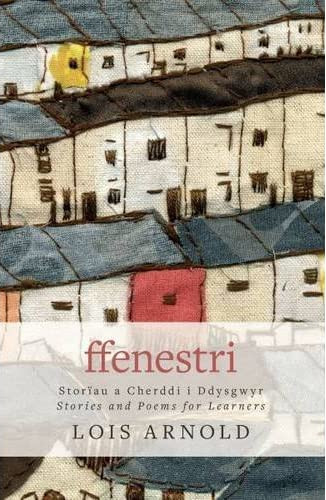
There's a real satisfaction the first time you finish reading a piece in a new language, and Lois Arnold makes it easy to be satisfied as everyone should find at least something that's within their ability. The stories and poems start using only the present tense, making them accessible even to those who are quite new to Welsh, and the reader is aided by a glossary of new terms at the bottom of every page. The difficulty level then gradually increases as new words and tenses are introduced. The stories and poems cover myriad subjects from cases of mistaken identity, to muddy festivals, space exploration and quiz nights. And they're not just filler material; each story and poem is a good piece in its own right.
I got great enjoyment from Ffenestri and it's a book I would recommend to anyone just starting out in Welsh. The short nature of the pieces means you don't get bogged down in a long story, and if you happen to pick something a little too difficult you're not stuck with it for the long run. The glossary means you're not constantly referring to a dictionary and thus interrupting your flow and enjoyment of the material.
I admit, I've been a bit remiss in both updating this site and in learning Welsh.
The problem is finding the time.
A while ago, back in July, I lost my DuoLingo streak of more than two years and with it any incentive to keep up with my DuoLingo practice.
I suppose that's the problem with DuoLingo: once the addiction of keeping your streak going wears off, and if you've already completed the language tree, there's not much to keep you going back, as it's all just more of the same.
I could have carried on with Say Something In Welsh, but again it's finding the time. I used to do it while driving, but I generally prefer to listen to radio comedy these days, so my Welsh gets neglected.
And I know my Welsh is suffering for it, as I keep encountering words that I know I know, but of which I can suddenly no longer remember the meaning.
I need to make more of an effort. I'll keep you posted!
(This has nothing to do with Welsh)

About
Around 12 years ago I wrote and released a small PC game called "Help Hannah's Horse". It was essentially a variation on Pacman - collect the coins scattered about the maze while avoiding the ghosts and gathering the moving carrots and the powerups that appear from time to time. A few people played it and it got included in the Debian Linux repositories.
Recently I got thinking about that game again and thought it would be nice to give it a bit more polish and change the music. The music particularly has always niggled me; not because it's bad (it's great!) but because I found it online and just used it. I never credited the composer and never checked if it was free for non-commercial use. I have no idea where I found it, so unfortunately I can't correct this now. I don't even know the name of the piece as I renamed the file to just "bgm1.ogg". I needed to either find royalty-free music that fit the mood of the game, or write a piece myself. I took the latter approach.
Anyway, after a couple of weeks of tidying code, fixing bugs, composing music and redrawing some graphics, I have released version 1.2 of the game!
Screenshot

Here's Hannah merrily running around level 1 collecting the gold coins and moving carrots and avoiding the ghosts. The green potion makes Hannah invulnerable for a short time if she collects it.
Download
It's available on my Sourceforge page (http://hannah.sourceforge.net) for Windows and in source code form for other platforms, if you're so inclined. There's a Makefile for Linux included.

About
Around 12 years ago I wrote and released a small PC game called "Help Hannah's Horse". It was essentially a variation on Pacman - collect the coins scattered about the maze while avoiding the ghosts and gathering the moving carrots and the powerups that appear from time to time. A few people played it and it got included in the Debian Linux repositories.
Recently I got thinking about that game again and thought it would be nice to give it a bit more polish and change the music. The music particularly has always niggled me; not because it's bad (it's great!) but because I found it online and just used it. I never credited the composer and never checked if it was free for non-commercial use. I have no idea where I found it, so unfortunately I can't correct this now. I don't even know the name of the piece as I renamed the file to just "bgm1.ogg". I needed to either find royalty-free music that fit the mood of the game, or write a piece myself. I took the latter approach.
Anyway, after a couple of weeks of tidying code, fixing bugs, composing music and redrawing some graphics, I have released version 1.2 of the game!
Screenshot
Here's Hannah merrily running around level 1 collecting the gold coins and moving carrots and avoiding the ghosts. The green potion makes Hannah invulnerable for a short time if she collects it.
Download
It's available on my Sourceforge page (http://hannah.sourceforge.net) for Windows and in source code form for other platforms, if you're so inclined. There's a Makefile for Linux included.
I've realised that this blog has strayed somewhat from my original aim of it being about my journey of learning Welsh, and more just my opinion on various language-related things.
So, in a return to its true purpose, this post is a review of the book "Yn Ei Gwsg" (In His Sleep) by Bethan Gwanas.
Dafydd walks in his sleep. It's part of the reason, he suspects, for the breakup of his marriage and it gets him into all sorts of odd situations with his neighbours. One morning, however, it takes a more sinister turn when he wakes up covered in blood - not his own - and sets off with his faithful dog Wmffra to follow the bloody footprints to find out to whom the blood belongs.
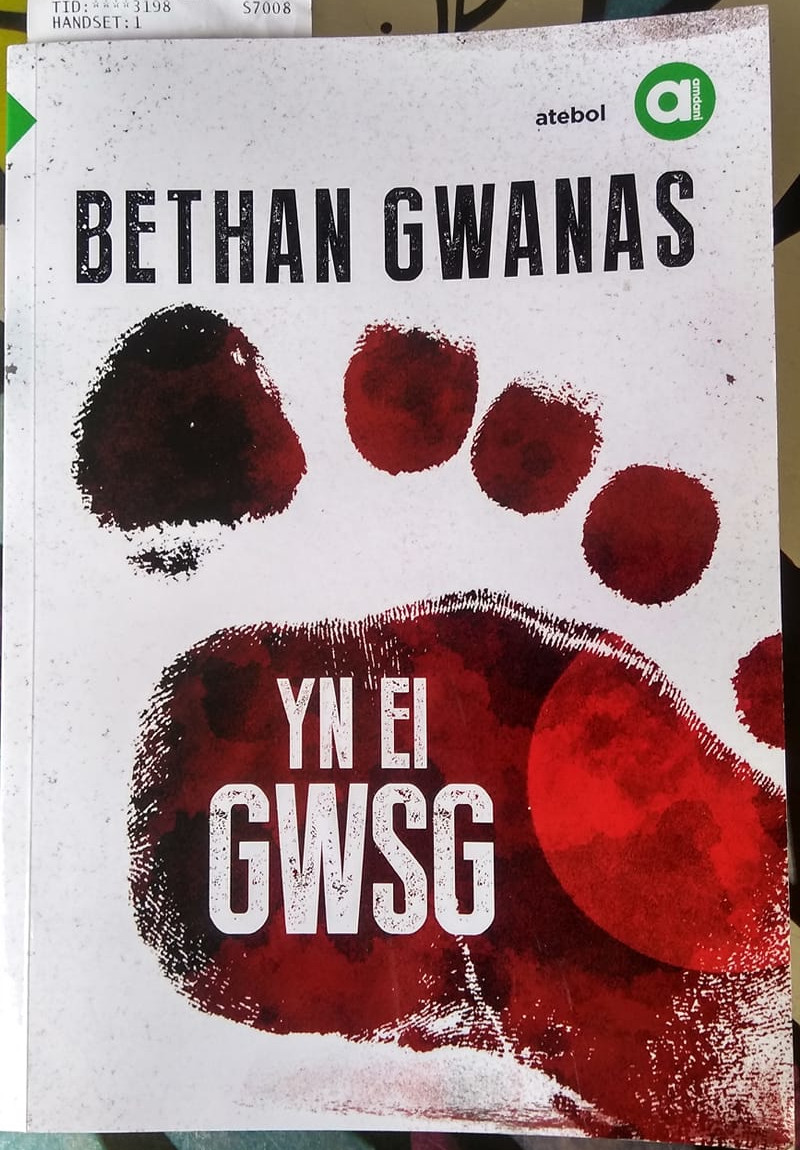
The book is not nearly as dark as that synopsis makes it sound. It's actually very light-hearted, humorous and a touch sad in places. Bethan Gwanas writes novels for native Welsh speakers as well as learners, and I think that helps her keep this novel simple yet clearly aimed at adults. The language used has clearly been thought about so that the level remains suitable for the target audience, yet also shows a progression from start to finish and introduces new words and phrases.
I really enjoyed reading it. Unusually for me, I found I could hardly put it down. I think this was partly because it was genuinely an enjoyable story, and partly because the level was pretty much spot-on for my ability (this is set as Lefel Sylfaen) so I found I was able to read straight through most pages without having to resort to a dictionary (the glossary of new terms at the bottom of each page, as is common for Welsh-for-adults books, helps enormously). The language used is more northern in style, but I didn't find this a hindrance at all - in fact it helped to cement some knowledge of northern dialect that I'm bound to encounter in the wild anyway.
The last book I read before this was "Ffenestri" by Lois Arnold. If you've read up to the end of the Sylfaen level in that, you shouldn't have any problems with this and I'd recommend it as not only a good book for learners, but a good read in its own right.
So, in a return to its true purpose, this post is a review of the book "Yn Ei Gwsg" (In His Sleep) by Bethan Gwanas.
Dafydd walks in his sleep. It's part of the reason, he suspects, for the breakup of his marriage and it gets him into all sorts of odd situations with his neighbours. One morning, however, it takes a more sinister turn when he wakes up covered in blood - not his own - and sets off with his faithful dog Wmffra to follow the bloody footprints to find out to whom the blood belongs.
The book is not nearly as dark as that synopsis makes it sound. It's actually very light-hearted, humorous and a touch sad in places. Bethan Gwanas writes novels for native Welsh speakers as well as learners, and I think that helps her keep this novel simple yet clearly aimed at adults. The language used has clearly been thought about so that the level remains suitable for the target audience, yet also shows a progression from start to finish and introduces new words and phrases.
I really enjoyed reading it. Unusually for me, I found I could hardly put it down. I think this was partly because it was genuinely an enjoyable story, and partly because the level was pretty much spot-on for my ability (this is set as Lefel Sylfaen) so I found I was able to read straight through most pages without having to resort to a dictionary (the glossary of new terms at the bottom of each page, as is common for Welsh-for-adults books, helps enormously). The language used is more northern in style, but I didn't find this a hindrance at all - in fact it helped to cement some knowledge of northern dialect that I'm bound to encounter in the wild anyway.
The last book I read before this was "Ffenestri" by Lois Arnold. If you've read up to the end of the Sylfaen level in that, you shouldn't have any problems with this and I'd recommend it as not only a good book for learners, but a good read in its own right.
If you're spending more time at home at the moment than perhaps you'd like, one of the ways to avoid going mad and to use the time productively is to learn a skill. Learn to paint, learn photography, learn an instrument, or... learn a language!
With so many resources for so many languages available online for free, now is a great time to start learning whatever language takes your fancy.
Obviously I would suggest Welsh, but learning any language is fun and often helps improve your understanding and appreciation of your own, native language.
So... if you're bored being at home and need something to do, that's my suggestion.
DuoLingo have just added Scottish Gaelic to their list of languages and, as someone who has lived on the Isle of Lewis where you can still hear the language spoken, I'm quite tempted to learn it.
But I won't. Not because I don't want to; I'd be fascinated to start understanding some of what I saw and heard while I was in the Outer Hebrides, but because I think I have my hands full with Welsh. Plus if I learnt every language that appealed to me I'd be learning almost every language available (with the exception of silly made-for-TV languages like High Valyrian and Klingon).
Still, it's great news to see a growing interest in another of the UK's indigenous language. It's important we keep our native languages alive for future generations. It's a part of our history, after all, and brings with it a rich cultural history.
Mae'n amser eisteddfod ar lein eto!
It's online eisteddfod time again!
Every year, alternating between locations in the North and South of Wales, is the National Eisteddfod (Eisteddfod Gynedlaethol), a celebration of Welsh language, music and culture with bands, singers, poets authors and more besides.
And every year, SaySomethingInWelsh.com runs an "Online Eisteddfod" for members and non-members to practice their Welsh by speaking, writing or singing reviews, poems, songs and prose that they've written. The entries are judged and a winner chosen for each category.
I really enjoy the online Eisteddfod. It gives me a chance to practice my Welsh and enjoy what others have created with theirs.
Last year I was the only entrant for the Beginner Prose category, so of course I won by default. This year I have entered the Englyn Milwr (a short, three line poem on a given theme) and the Post-Beginner Prose. I'm not sure my Welsh is really good enough for post beginner, but I didn't want to run the risk of being the only entrant for the beginner category again!
Entries close on 2019-11-14 and voting takes place the following week. Let's see how I do. Fingers crossed...!
Alongside Welsh, I have also been brushing up on my GCSE French and hoping to improve my German (although I've already given up on this).
These languages have highlighted two more things I like about Welsh and that I think make it an easier language for the beginner:
1. The present continuous (I am going; I am doing; We are sailing (across the sea...))
In English, we have this periphrastic construction for the continuous tense that involves using "to be" as an auxilliary verb. This construction is alien to other European languages who simply use the present tense form of whatever verb, for example "to go", to indicate all three of the following ideas:
I go
I am going
I do go
In French, all three are "je vais". On the DuoLingo forum you see beginners in non-Welsh languages ask "Where is "am" in this sentence?" or asking "Why is it not 'Je suis vais'?".
Welsh, similarly to English, also forms the present tense periphrastically with "bod" (to be), almost in the opposite way to French by including the auxilliary where in English it *wouldn't* be needed:
Dw i'n mynd (literally "Am I going")
is
I am going
I go
I do go
and I think that inclusion of "am" (dw, in this case) is a more familiar construct to the English speaker, despite the reverse word order.
2. The same pronouns are used for both the nominative and accusative case.
What I mean by this is that "he" and "him" are both the same word, as are "She" and "her" (although not "her" the possessive pronoun), and "We" and "us".
For example:
Maen nhw'n mwynhau'r ddrama (they enjoy the play) - Nominative
Uses the same pronoun as:
Paid ag anghofio nhw! (don't forget them!) - Accusative
In French, "them" can be "ils" or "elles" or even "eux" in the nominative and "les" in the accusative.
The more Welsh I learn, the more I think it's a lot easier than people give it credit for. That said, it's not without its own strange constructs!
Christmas has been and gone and I've now got a small collection of Welsh books aimed at learners. I already had "Ffenestri" by Lois Arnold, and I now have two Bethan Gwanas books to add to my growing library: "Yn ei Gwsg" and "Bywyd Blodwen Jones".
I've started the Blodwen Jones one, but to my shame I have only made it about three pages in. It's not because it's too difficult (it's actually about right for me), it's because life, as it is wont to do, has taken over.
That's also why I haven't been updating this blog very often: I just don't find the time.
My Welsh learning is still continuing apace though. My DuoLingo tree is now almost entirely level five (nothing below a four) and I've moved onto level two on Say Something In Welsh. The range of things I can say in Welsh now far outstrips what I can say in French, and I started learning that when I was 11 at school!
What I lack is someone to speak Welsh with. No one else in the house is interested in learning, and I suspect wouldn't stick with it long if they did. It may be time to venture out and maybe go to a meet up in Bristol or Casnewydd.
Last month, I completed the Welsh tree on DuoLingo. By "completed" I mean that I got all of the units up to at least level 2. That means I've covered material up to and including Canolradd level. I should be practically fluent by now, right?
Errr, no. I'm doing OK reading through my Welsh short stories book ("Ffenestri", by Lois Arnold - I highly recommend it) and I'm understanding more on Radio Cymru each time, but I just don't get enough chances to speak for my brain to engage quickly enough when I need to put a sentence together.
That said, DuoLingo has definitely helped broaden my vocabulary, and I'm often surprised by the sorts of sentences I can put together, but I don't think DuoLingo alone can get you fluency. For that, much more exposure to the spoken language and the way people speak it is needed.
I've started making it part of my morning routine to listen to the BBC's Welsh language offering, Radio Cymru, on the way to work. I don't listen for very long, only the 20 minute drive to work, but the idea is that it gets me used to hearing the language and its rhythms and tempo.
And I don't really understand very much of it. I can pick out quite a few words, but not enough to understand whole sentences, although I do have one complete sentence under my belt from the breakfast show one morning: "Mae'r plant yn hoffi y ceffyl, a'r ceffyl yn hoffi'r plant" (the children like the horse, and the horse likes the children). I can just about follow the weather, and if I know some of the topics already, I can understand a little of the news.
Hopefully as time goes on, and in conjunction with my other practices, I'll start to understand more. What's important to remember, and what another learner pointed out, is that Radio Cymru is aimed at *native* speakers; not learners, so being able to understand any of it is a bonus.
Following my first tuning-in, I tweeted that I'd started listening and got a reply and some likes from Radio Cymru presenters, which was encouraging. The reply simply said "Dal ati!" (keep at it). I intend to.
Actually I'm annoyed with myself.
And I'm annoyed with the people of Pembrokeshire! We went for a family holiday for a week to Pembrokeshire (beautiful, by the way) and I managed to speak almost no Welsh. The problem was mostly that I encountered virtually no one who spoke Welsh! Or at least no one who advertised the fact if they did.
I say "almost no Welsh" because I listed the items in my shopping basket in Welsh to my step-daughter, and I replied with "Dw i'n siarad tipyn bach Cymraeg, hefyd" when confronted with the reply of "tipyn bach" to my question of "Do you speak Welsh?" to a shopkeeper.
And that was it. I overheard someone at Castell Henllys speaking Welsh, but they'd gone by the time the demonstration I was watching had finished, otherwise I might have asked to practice a little with them (although God knows what I'd have said).
It's a shame, really. An opportunity missed. My Welsh comprehension is now getting beyond the Mynediad (entry) level, but my listening and speaking have had very little practice.
Still, I was at least surrounded by written Welsh: road signs, shop signs, leaflets, and I took the time to watch a little S4C, so all was not lost.
Ok, so it's been about seven months since I started learning Welsh in earnest, and he's what I think is hard and what I think is fairly easy about Welsh:
1. Mutations. Letters change at the start of one word depending on what word they follow. However I'm finding that this starts to feel more natural in most circumstances after a while.
2. Versions of "about" and "of/from" for each pronoun. If you're talking about a thing, they're "am" and "o" respectively. But if you're talking about/from me, you, her, him, us or them you're looking at "amdana, amdanat, amdani, amdano, amdanon and amdanyn" and "ohono, ohonot, ohoni, ohono, ohonon and ohonyn"!
3. The letter "Ll". Yes, it counts as one letter. The pronunciation is somewhere between ell and hissing like an angry goose with a headache. For some reason I find it easier to pronounce at the start of a word, like Llawr, than in the middle or end of a word, like Arall or Galla.
4. Conjugations. Well, this is the same for any language, really. Remembering the conjugations of short-form verbs is just one of those things you have to get used to.
5. Yes and no. There are no words for Yes and No in Welsh, you just repeat back (or negate) the appropriate conjugation of the verb in the question. "Do you like cheese?", "I do". "Are you tired?" "I am". "Are you reading?" "I am not". But that's only in the present tense. In the past tense it's usually "Do" for yes and "Naddo" for no. But then for emphatic questions it's "Ie" for yes and "Nage" for no. If the question was asking if there is something with you (see below) you reply with Oes or Nag Oes. Remembering which to use is the hard part.
6. There aren't many words that are similar to other European languages. There are some, mostly more modern words borrowed from English: tacsi, parcio, ffatri, ffôn, beic, etc; and some ecclesiastical words like eglwys (church) and capel (chapel) but not to the extent that you find with Romance or Germanic languages.
Things that are easier than I expected:
1. Mutations. Yes, they're difficult, but actually you get used to them, and in many cases the rules are quite consistent. You just get used to dropping the G in words like gweithio and gweld when they follow a sentence subject. You get used to changing D to Dd in adjectives after "yn", and you get very used to nasal mutations after "fy".
2. Conjugations. Although remembering them is difficult, many of the conjugations are quite consistent and actually fit in quite well with the pronoun they go with.
3. Possession. I've said before about there being no form of "I have a (something)" in Welsh, they instead say something is "with them": Mae ci gyda fi - "There is a dog with me". I got the hang of this much quicker than I thought. I think you just change your way of thinking and everything slots together.
4. The language as a whole. I'm only a beginner. Very much so. But I've been surprised at how much I've covered in such a short space of time. I'm not proficient by any stretch of the imagination, and I can only string together fairly simple sentences, but on the other hand I can make many more types of sentences in Welsh than my partner's daughter can in Spanish; a language she's been learning at school for two years now. I can use the present tense, the past perfect, a sort of imperfect, the future in several forms and some conditional tenses and even a kind of limited subjunctive mood.
On the whole, Welsh has (so far) been easier than I expected. It's not the incomprehensible jumble of letters it always looked like on road signs when we used to visit my Grandma in Rhossili when I was a child. In fact, in many ways it's a lot easier than the languages I'd been taught at school.
This is something I've started feeling quite strongly about lately, although I admit I'm partial to a bit of bias given my current enthusiasm for Cymraeg, but...
...why don't we teach Welsh as a second language in England? I say England because in Scotland and Northern Ireland they already have native languages that should be taught, but England does not.
I know some people will think, "Are you mad?!" but hear me out; my reasoning is sound:
1. Many children are more likely to visit Wales than Germany. German is taught in many British schools, yet British tourists to Germany number around 2 million per year compared to 10 million in Wales (2015 figure). This means more chance to practice a language learnt in school.
2. Welsh is the language of these islands. English people may not appreciate this, but our ancestors spoke something similar to Welsh. Before the Romans, Saxons and then Normans invaded, the native languages of these islands were the Brythonic languages, of these Welsh is the one currently in the healthiest state. Learning Welsh is a link to our past, even as Englishmen.
3. Learning any language has benefits beyond just that language. Learning one language helps a child understand other languages and their own language much better. There is nothing to be lost by learning Welsh and much to be gained.
4. Welsh is different. Welsh is not like French, German or Spanish; the languages children usually learn in school. The structure is different and it borrows little from Romance or Germanic languages. Learning Welsh gives children a different perspective on language learning yet remains relevant as it's spoken as a living language by 700,000 people and is an official language of the UK, unlike Cantonese, Mandarin or Satsuma ;)
5. Welsh is easy. Well, sort of. As I've covered previously, simple Welsh sentences in the past, present and future tenses can involve very little conjugation beyond the verb "bod" (to be). This makes progress fast and enthuses children to learn. Why spend two years mastering present tense conjugations in French when you can learn the same sentences in Welsh in a fraction of the time?
Not everyone will agree with me. I know the counter argument will be "but more people speak language X than speak Welsh!" or the usual "Welsh is a dead language! What's the point?!". But Welsh is growing. By teaching it as a second language it will grow more and these questions will answer themselves.
Today I completed my first challenge on Say Something In Welsh, which was to say a sentence constructed around each of the below words and phrases out loud within five minutes:
I want to
I'm going to
I can't
I need
What
But
I wanted
I've just started
I've forgotten
I was trying
...that I need...
I must
I would like to
no doubt those passing me thought I was a little odd, as I sat in my car in McDonald's car park talking, mostly, about how I need to feed the dog, eat a burger or go to the pub!
Still, I feel I've achieved something. I shall wear my pink badge with pride (well, my avatar on the forum will).
The next challenge is to record the sentences and post them for the world to see. Oooeeer!
My last post was about starting the Say Something In Welsh course. This is just an update on how that's going.
First, the main difference between this and DuoLingo is the sense of community. The DuoLingo forums (if you can call them that) are really only for people asking questions about the lessons themselves, or querying the correct answers to questions within the lessons. The Say Something In Welsh forums have much more spirit about them. People joke with each other, people ask questions, get replies and then go off topic about their experiences of learning Welsh. People share their real world experiences of *using* Welsh and receive encouragement from others for doing so. And, most importantly, the course creators and contributors also join in with all of this. And there's never a hint of condescension, just encouragement. This tone is maintained through the lessons themselves, with one of the later sentences on the very first lesson being "I'm not trying to speak Welsh, I am speaking Welsh" (Dw i ddim yn trio siarad Cymraeg, dw i'n siarad Cymraeg!)
Second, the course takes some getting used to for someone like me who has done a little Welsh before. The pronunciations are a little more colloquial, and words are omitted in the same way that a native speaker might: "Wyt ti'n bwyta" (you are eating) becomes simply "ti'n bwyta", in much the same way as an English speaker might ask simply "You eating?"
Then there's the manner of the course. Everything is very relaxed. You're told "don't worry about this now" when introduced to things like mutations and the long form of the past tense. You're told, "To form the past tense, you only need to know how to say "ness ee". This stumped me, until I realised it was just a colloquial pronunciation of what I know as "Mi wnes i". I'm not sure how well I cope with this casual approach. I **need** to know conjugations, I **need** to know why things are what they are. It's very hard for me to just let go and accept that things are as they are, and it will all become clear later.
But I'm trying. The course clearly works, as plenty of people on the forums are using it, and Iestyn is an excellent teacher. His lessons are well measured, his voice is clear, he's encouraging throughout, and he participates in the forums to answer questions and give advice.
He is clearly passionate about Welsh, and that enthusiasm is infectious.
I originally signed up to the SaySomethingInWelsh forums a few weeks ago when I found it quite by accident while searching for information on the use of "sydd" vs "pwy", and my use of the site didn't go beyond reading some of the forum posts.
Today I decided to start their lessons. Learning with SaySomethingInWelsh is quite unlike DuoLingo. The latter presents you with very short lessons based around short sentences you translate into English, write out in Welsh, or match to pictures. Because of its visual nature, learning the written forms of words is essential to the learning process.
SaySomethingInWelsh is quite different. They actively discourage note taking and base their lessons entirely on listening and repeating the material in a fashion a little similar to a Teach Yourself CD. The idea is that you learn by doing.
Despite having worked up to Level 16 on DuoLingo, I decided to start right at the beginning with the SaySomething course, just in case it offered vocabulary I had not come across on DuoLingo, and so that I got the most out of the course.
So far I'm liking it. It's ideal for having in the car while driving, as one might an audio CD. The only disconcerting thing at the moment is the pronunciation of the speaker, who is a native speaker from the South East. I'm familiar with pronouncing words with "ae" to sound as "eye", whereas he pronounces them more like "ah". Thus "cymraeg" to me sounds like "cum-rye-g" but to him is more "cum-raag". I'm not going to argue with him; he's a native speaker, after all, but it takes some getting used to. I can only assume my pronunciation is either more "standard" or more northern.
Even lesson one brought about some new-ish vocabulary for me, so it's looking like a promising new route for learning, with the added bonus of some forums in which to speak to some like-minded learners.
On Saturday I was crossing the Second Severn Crossing into Wales and, of course, I stopped at the toll booth to pay the crossing toll. The man operating the booth greeted me with a fairly cheery, "Hello" and I replied likewise, paid, thanked him and drove off. As we left, Lulu said, "Why didn't you say thank you in Welsh?" and I replied "Because I didn't know if he spoke Welsh".
I know I've mentioned this previously, but it still strikes me as odd. I'm entering Wales, but I can't guarantee that the (presumably) Welshman I'm talking to can speak the language of his nation. Later in the supermarket, the same thing. The (very clearly) Welsh lady greeted me, we had a chat about the weather and Cardiff in general, I thanked her and I left. Again, it would have been great to practice a bit of Welsh with her, even a "S'mae!" or "Prynhawn da", but again I couldn't be sure that she'd be able to speak Welsh.
Funnily enough I'd have been more confident that younger people spoke the language than older people, due to the push that's been made in recent years with teaching it in schools and some schools being entirely Welsh medium. This is in contrast to other indiginous languages of the UK, such as Scottish Gaelic, where the vast majority of speakers are older people and the languages are, quite literally, dying out.
The Welsh government is pushing for 1,000,000 Welsh speakers by 2050, and DuoLingo reports more users than that learning Welsh now, although I don't know how many live in the UK, so hopefully it won't be too long before I can know beforehand that it's safe to speak Welsh to a Welshman in Wales!
Sometimes I see people on the DuoLingo forums say that they ultimately want to become fluent in the language they're studying. That strikes me as a lofty ambition.
For someone living in the country of the language they're learning, fluency as a goal makes sense, and in my opinion is probably achievable. Most language learners and teachers agree that the best way to become fluent is to immerse oneself in the language, and the best way to do that is by living in a country where it's spoken.
For someone not living in a country where their language is spoken, fluency must surely be much harder to achieve. Independent study, including reading and watching television programmes in the target language, can increase proficiency (I can't imagine there's such a thing as bad exposure to a language) but ultimately the way to fluency is to hear native speakers. Language, after all, is defined by its use as much as its rules. Language learning with no exposure to its actual use can, however, lead to the sort of hilarity found in the classic English As She Is Spoke.
I think goals need to be achievable and realistic in order to avoid discouragement. It's better to set a low bar, reach it, and then move on to the next target with a sense of acheivement than to reach too high and become discouraged at an apparent lack of success.
My goal with Welsh is definitely not to become fluent. Not at the moment, anyway. I don't think I'd stand a chance without being surrounded by Welsh speakers and using it every day. My aim is simply to be good enough to understand all the Welsh signs when I'm visiting Wales, to be able to conduct a simple transaction in a shop (actually I'm not that far off, if all I want is a coffee!) and to be able to read novels aimed at learners.
If you're learning a language, one of the best ways to gain exposure to that language and increase fluency is to visit a country where that language is spoken.
Herein lies the problem with Welsh: not all Welsh people speak it. They all speak English, but only around 20% of the population speaks Welsh. This means that if I'm in Wales, I can't initiate a conversation in Welsh because I can't guarantee that the other person will be a Welsh speaker.
Such a situation, where a native does not speak the native language, would be inconceivable in most other countries.
The fact that there are no monoglot Welsh speakers remaining also doesn't help. Because everyone speaks English fluently there's less incentive to make the effort to learn and speak Welsh.
Then there's the problem with signage. In France, other than at some touristy areas, all signs are in French. Signs alerting me to the "dèrniere sortie avant péage" will do so only in French. Translating and understanding the signs becomes part of the learning experience. Unfortunately, in Wales most signs are bilingual. The order of the languages is left to the discretion of the local authority, but an English translation will be on the sign somewhere. On the one hand, this allows you to quickly confirm that your translation of the Welsh was correct. On the other, it takes a lot of the fun and the necessity out of translating in the first place. It's very hard not to notice the English accidentally before you've had chance to attempt the Welsh.
What I have discovered, to my surprise and delight, is that several of my colleagues speak varying levels of Welsh. Remember, this is Somerset, England, not the north of Wales, so it's not entirely expected. One even speaks fluent Welsh, having attended a Welsh medium school. And he's said he's always happy to help with my Welsh learning.
So things are looking up.
Here's an odd one: the Welsh have no word for "to have", as in to possess something.
The Welsh, though, are a resourceful lot and get around this apparent limitation by saying that something is "with" something else.
I do not have a ball, a ball is with me. Likewise, a new house is with me; a girlfriend is with me; even a beard is with me.
The concept isn't complicated, but I find it tricky to get the word order right. During a conversation at work, I was asked if I knew how to say "The red dog has a ball" in Welsh. I had to think about this. Is the red ball with the dog, or is the dog with the red ball? I eventually settled on the former: mae pêl gyda'r ci coch. I think that's right.
It doesn't trip off my tongue quite as easily as it would in, say, French: Le chien rouge a un ballon. It's a little clumsy and awkward, but that's part of the charm.
This problem isn't limited to possessing an object (or a girlfriend) though. It rears its head when talking about health too. You don't have a sore throat, there is a sore throat with you. You do not have a cold, there is a cold "on you": Mae annwyd arna i.
Let's hope I don't get sick while in Wales; this might take some getting used to.
One of the more daunting things about Welsh which is common to all the Celtic languages is the concept of mutations: consonants that change to a different letter, or even group of letters, depending on context.
As an English speaker and someone who has learnt German and French in the past, this is a truly alien concept. German may have given us some pretty monstrous words, but at least they're always spelt the same way whenever you encounter them. The French may be sloppy when pronouncing the ends of their words, but at least the beginnings don't go changing.
In Welsh, however, certain initial consonants of words change to other consonants. This is a mutation, and exists in all the Celtic languages of the British Isles in various forms. Welsh has three types of mutation: soft, nasal and aspirate (which I won't go into here). The most common of these is the soft mutation. What this means, in practical terms, is that in certain circumstances the following letter changes occur at the start of a word:
c becomes g
p becomes b
t becomes d
d becomes dd
b and m become f
ll becomes l
rh becomes r
and g vanishes entirely!
One of the occasions these mutations occur is when a singular feminine noun follows the definite article "Y". So "cath" (a cat) becomes "y gath" (the cat). "Mam" (Mother) becomes "y fam" (the Mother). And so on. This change also occurs when we are going "from" or "to" somewhere. If we go "to Wales", for example, it's "i Gymru" with the usual C replaced by a G. I'm still getting accustomed to the various reasons for the soft mutation, and there are lots of them.
Then we have the nasal mutation. This is much less common, and comprises the following consonant changes, which I had to look up because they're not all yet very natural to me:
p -> mh
t -> nh
c -> ngh
b -> m
d -> n
g -> ng
I've principally encountered this mutation when saying I am "in" somewhere. As with the Cymru -> Gymru change above when we go to Wales, we change C to Ngh when we are in Wales. So one can like Cymru, go to Gymru, but be in Nghymru... argh! Still, all languages have their quirks, and the world would be a very boring place without these differences.
The purpose of mutations, so I've been led to believe, is to improve the flow of the language. I kind of buy that. Kind of. I can see that the words trip off the tongue a little better in the case of the nasal mutation ("my car" would be "fy car" ("vuh car") without the change but becomes "fy nghar" ("vunghar") with it), but I can't really see how abitrary changes to feminine singular nouns help the flow.
Still, it is what it is, and it's all part of language's rich tapestry!
The first tense I'm learning in Welsh is the present tense. When I started learning Welsh I held the opinion that it was a difficult language full of complicated constructs that I'd struggle to learn compared to French, Spanish or German.
Turns out I was wrong. Forming the present tense in modern colloquial Welsh (literary Welsh is quite different) is probably the easiest of any language I've learnt. The reason is thus: all simple present tense sentences involve conjugation of the same verb, "bod" (to be) followed by your action verb in its infinitive form (called a verb-noun, in Welsh).
So, where in French you'd need to know the first person singular and plural, second person singular and plural, and third person singular and plural forms of every verb you want to use, in Welsh you need only know the various conjugations of bod and the infinitive form of the other verb.
"I am swimming" is "Dw i'n nofio", where "dw" is the form of bod and nofio is to swim.
"He is swimming" is "Mae e'n nofio". "She is swimming" is "Mae hi'n nofio".
"I am eating" is "Dw i'n bwyta". "He is eating" is "Mae e'n bwyta".
And I really love this about Welsh. Forming a whole range of new sentences only involves learning one form of each new verb. It's so wonderfully consistent, and it lets you feel you're making progress almost instantly.
Five months or so ago, I embarked on a language learning adventure. I decided to learn Welsh. I'm not Welsh, I don't live in Wales, and I'm not planning on moving to Wales any time soon. Not that Wales isn't a lovely place, but it's not currently part of my plans.
It started as a bit of a joke. My partner's daughter, Lulu, started at Cardiff University last autumn and has the option of taking free Welsh lessons as part of her course. She scoffed at the idea, "Everyone speaks English! Why would I need to learn Welsh?". I explained that it might not be necessary, but why not take advantage of a free route to learning another language, but to no avail.
I can't say I blame her; I'd always been dismissive of the minority languages of the United Kingdom: Welsh, Gaelic, Cornish. They're dying out, aren't they?
Well, yes and no. Cornish is down to just a few scores of speakers and Gaelic has only around 50,000. But Welsh is a bit different. Welsh is still used. And it's still used by young people, for some of whom it's both a native and a first language. In fact, following a decline in the first half of the 20th century, Welsh is actually thriving somewhat, with the aim set by the Welsh Assembly to get one million speakers by 2050.
So back to Lulu. Every time we spoke following her enrollment at university I would ask her "Learning Welsh yet?" and every time she'd say "no", getting increasingly fed up with me asking, until one day she snapped, "If you love Welsh so much, why don't you bloody learn it?!". I saw that as a challenge and tentatively started looking for resources online.
My first port of call was Babbel, which I'd used in an aborted attempt to learn Spanish before, but alas they offer no Welsh course. I then found some excellent YouTube videos from WelshPlus, but they focussed entirely on familiarisation with the Welsh alphabet and pronunciation. Then someone suggested DuoLingo. DuoLingo courses are run by volunteers, who use the DuoLingo platform tools to create content to teach others. And DuoLingo has a Welsh course. And it's free. I signed up and dived into Cymraeg!
So, I'm now a Welsh learner, or Dysgwr Cymraeg, and I intend to chart my Welsh odyssey here.
Welsh, like most European languages, assigns nouns a gender. Some of these are obvious: a man (dyn) is masculine. A woman (menyw or dynes) is feminine. A cat (cath) is feminine. A dog (ci) is masculine. Well, that makes sense to me, at least.
But what's a table? Or a bed? Or love?
And how do we differentiate between them? And how do we learn the gender of a new object?
Well, in other European languages you can tell whether a noun is masculine or feminine by the article in front of it. In French, we have the indefinite articles "un" and "une" and the definite articles "le" and "la". When you learn a new word you also learn the gender. While on holiday in Paris in 2003 I asked "Qu'est-ce que c'est?" while holder up a token to use the toilet in a bar, and I got the answer "un jeton". Un. Masculine. And I've never forgotten that a token, in French, is masculine: "un jeton".
So what about Welsh? Welsh doesn't have an indefinite article at all. There is no way of saying "a table" or "an apple", it's just "bwrdd" and "afal". There IS a definite article ("the table" or "the apple") and it has three forms:
Y for words following and preceding a consonant
Yr for words preceding a vowel, but following a consonant
'r for words following a vowel (regardless of what follows it)
Sadly, none of these differentiate by gender, so it's almost impossible when learning a new word as part of conversation or when reading to tell whether it's masculine or feminine. And it's this that is, so far, the most frustrating thing about learning Welsh. I find myself looking up words that I already know just to determine their gender. While writing this I had to check to see if "coffi" (coffee) is feminine (it isn't).
So, does that matter? Well, yes! Welsh also has no gender-neutral word for "it". When talking about an object you refer to it as either he or she depending on its gender. When talking about the weather, for example, you refer to "she". "Mae hi'n oer" is "it's cold", only it's really "she's cold". And not only that, but certain words mutate in certain ways depending on context and gender. Would a Welsh person understand you if you were to get a gender wrong? Yes, of course. But it would grate. It wouldn't sound right. And if I'm going to learn a language, I'm going to do it right.